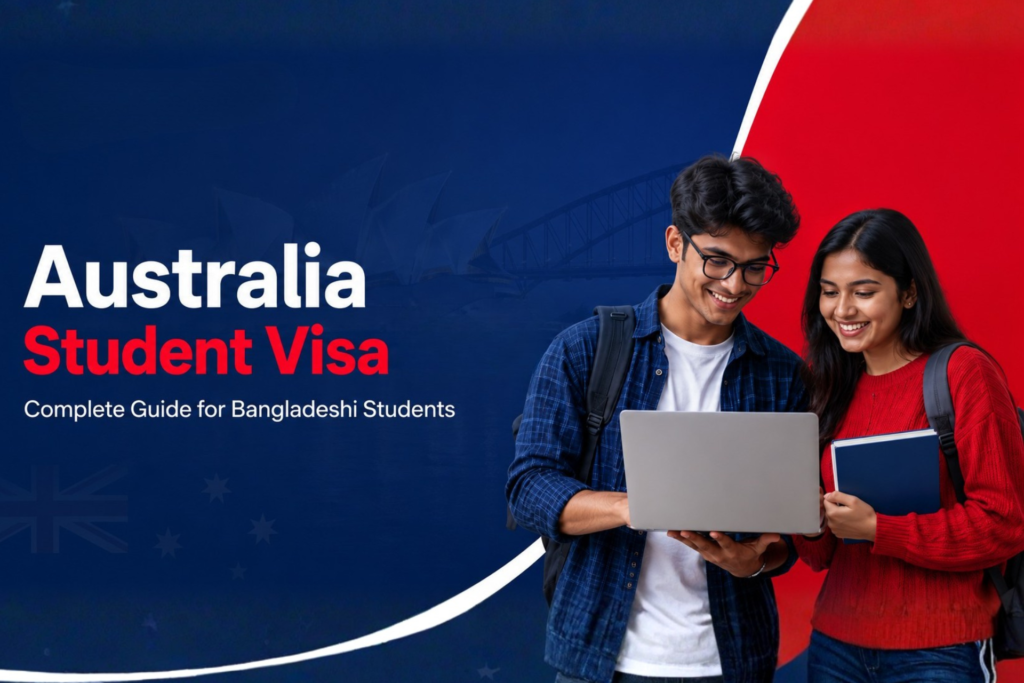
Planning to study in Australia from Bangladesh involves more than receiving an offer letter. You need to select a suitable course, meet the admission conditions, prepare credible financial evidence, and submit a Student visa application that is consistent from beginning to end.
The Australian Student visa is officially known as the Subclass 500 Student visa. From 1 July 2026, the standard application charge starts from AUD 2,500. Applicants generally need a valid Confirmation of Enrolment, Overseas Student Health Cover, sufficient financial capacity and evidence that studying is the primary reason for applying.
This guide explains the complete process for Bangladeshi students, including the points where careful course selection, document preparation and professional guidance can prevent avoidable problems.
Australia Student Visa 2026: Quick Overview
| Requirement | Current information |
| Visa name | Student visa, Subclass 500 |
| Application charge | From AUD 2,500 |
| Maximum stay | Generally up to 6 years |
| Student living cost benchmark | AUD 29,710 for 12 months |
| Standard IELTS score | Overall 6.0 |
| Standard PTE Academic score | 47 |
| Work rights | Up to 48 hours per fortnight during study periods |
| Application method | Online through ImmiAccount |
| Main enrolment document | Confirmation of Enrolment, or CoE |
| Health insurance | Overseas Student Health Cover, or OSHC |
| Student assessment | Genuine Student requirement |
The exact requirements can vary depending on your course, education provider, passport, previous education and personal circumstances.
What Changed for Australian Student Visas in 2026?
The Student Visa Fee Increased
From 1 July 2026, the standard Subclass 500 application charge starts from AUD 2,500 for the main applicant.
Limited concessions are available for certain applicants, but Bangladeshi students should normally budget for the standard charge unless the official Visa Pricing Estimator shows otherwise. Additional charges may apply when a spouse or child is included.
Offshore Applications Follow a Priority System
Applications submitted from outside Australia on or after 14 November 2025 are processed under Ministerial Direction 115.
For many higher education and vocational applicants, the processing priority can depend on the status of the education provider connected to the main CoE.
The three categories are:
- Priority 1
- Priority 2
- Priority 3
The priority affects when processing is likely to begin. It does not change the eligibility criteria or decide whether the visa will be granted.
This makes course and provider selection important for more than admission alone. When Rico International helps a student compare options, the review can include the course structure, tuition, entry requirements, location, career relevance, and the provider information available at the time of application.
What Is the Australia Student Visa Subclass 500?
The Subclass 500 visa allows eligible international students to:
- Study in an eligible Australian course
- Travel in and out of Australia while the visa is valid
- Work within the conditions attached to the visa
- Include eligible family members
- Remain in Australia for the period granted
The visa may be granted for up to six years, depending on the course type, enrolment period and individual circumstances. Students can generally work up to 48 hours per fortnight while their course is in session. Research master’s and doctoral students are not subject to the standard work-hour limit after their course begins.
Australian Student Visa Requirements for Bangladeshi Students
1. Select a CRICOS-Registered Course
Your course must be offered by an institution registered on CRICOS, the Commonwealth Register of Institutions and Courses for Overseas Students.
Before paying a tuition deposit, check:
- The institution name
- Campus location
- Course title
- CRICOS course code
- Tuition fees
- Course duration
- Entry requirements
- Intake date
- Available progression options
Selecting a course only because it appears affordable can create problems later. The course should also make sense in relation to your academic background, employment history and future plans.
This is one of the first stages where an education consultancy can provide practical value. Rico International can help students compare eligible institutions and identify courses that better match their qualifications, budget and intended career direction.
The final course decision should, however, remain the student’s own informed decision.
2. Receive a Confirmation of Enrolment
After receiving an offer, meeting the admission conditions and paying the required deposit, the institution may issue a Confirmation of Enrolment.
A valid CoE is normally required when lodging the Student visa application. Students applying for packaged courses must usually provide CoEs for all intended courses included in the package.
Before using the CoE, check that it correctly shows:
- Your full name
- Course name
- Institution
- Campus
- Start date
- End date
- CRICOS code
Errors should be corrected before the visa application is submitted.
3. Meet the Genuine Student Requirement
The Genuine Student requirement applies to Student visa applications lodged on or after 23 March 2024. It replaced the former Genuine Temporary Entrant requirement.
Applicants must show that studying is the primary reason for applying for the visa. The assessment considers the applicant’s circumstances, course choice, understanding of the program and the value of the qualification to their future.
The application includes questions about:
- Your current personal and economic circumstances
- Your family, community and employment ties
- Why you selected the course
- Why you selected the institution
- Why you want to study in Australia
- How the qualification may benefit your future
- Other relevant information about your application
How to Prepare Strong GS Answers
Your answers should connect your past, present and future.
For example, explain:
- What you have studied or done professionally
- Why the proposed course is a logical next step
- Why the institution and course are suitable
- What skills you expect to gain
- How those skills relate to your career plan
Avoid generic statements such as:
Australia has a world-class education system and multicultural environment.
That statement may be true, but it does not explain why your specific course and institution make sense for you.
A stronger answer would connect the course modules, your existing education and your intended career.
Students often struggle with this section because the application must remain consistent with their academic documents, employment history, financial evidence and previous immigration information.
Rico International can help students organise the information, identify gaps and review whether the overall explanation is consistent. The answers must still reflect the student’s genuine circumstances. No consultancy should invent employment, financial or personal information.
4. Meet the English Language Requirement
For approved tests taken on or after 7 August 2025, the standard minimum visa scores include:
| Test | Standard minimum |
| IELTS Academic | 6.0 |
| IELTS General Training | 6.0 |
| PTE Academic | 47 |
| TOEFL iBT | 67 |
| CELPIP General | 7 |
| LANGUAGECERT Academic | 61 |
| Michigan English Test | 53 |
Lower thresholds may apply when an eligible course is packaged with an approved English language, foundation or pathway program.
The visa requirement and university admission requirement are not necessarily the same.
For example, the Student visa may accept an IELTS score of 6.0, while a university may require:
- IELTS 6.5
- A minimum score in each component
- A higher score for nursing, teaching or another regulated course
Students should check both requirements before applying.
When Rico International shortlists a course, the English requirement should be reviewed alongside the student’s current score. This helps determine whether the student can apply directly or may need an English language or academic pathway.
5. Show Sufficient Financial Capacity
Depending on the document checklist, you may need to provide evidence that you have enough money for:
- Travel to Australia
- Tuition fees
- Your living expenses
- Living expenses for accompanying family members
- School costs for school-age dependants
The current 12-month living cost benchmarks include:
| Applicant | Living cost benchmark |
| Student | AUD 29,710 |
| Partner | AUD 10,394 |
| Each child | AUD 4,449 |
Applicants outside Australia should generally include AUD 2,000 per person when calculating travel costs.
Example Financial Calculation
Suppose your costs are:
- First-year tuition: AUD 28,000
- Tuition already paid: AUD 8,000
- Remaining tuition: AUD 20,000
- Living cost requirement: AUD 29,710
- Travel cost: AUD 2,000
Your indicative calculation would be:
AUD 20,000 + AUD 29,710 + AUD 2,000 = AUD 51,710
This is only an example. Your amount will depend on your tuition, payments already made, and accompanying family members.
Financial Evidence May Include
- Bank deposits
- An education loan
- A government loan
- A scholarship
- Other documented financial support
Having the required balance alone may not be enough. Applicants may also need to demonstrate genuine access to the funds and explain how the money was accumulated.
The Department recommends supporting deposits with transaction history, income patterns or other evidence showing the source of the funds. A one-day bank balance certificate may not adequately explain how the amount was obtained.
This is a common area of difficulty for students and sponsors. Rico International can help organise the financial document checklist and identify inconsistencies between the declared sponsor, bank records and application information.
However, the consultancy cannot replace genuine funds or create unsupported financial explanations.
6. Arrange Overseas Student Health Cover
Students and accompanying family members must generally maintain Overseas Student Health Cover for their stay in Australia.
For applicants outside Australia, the cover should begin from the date they intend to arrive, not simply from the first day of classes.
Check that the policy shows:
- The correct student name
- Correct coverage dates
- Appropriate family coverage
- An approved OSHC provider
The cost depends on the provider, duration and number of people covered.
7. Meet Health and Character Requirements
Depending on your circumstances, you may be asked to provide:
- A health examination
- Biometrics
- Police certificates
- Identity documents
- Additional character information
Follow the instructions in ImmiAccount. Not every applicant receives exactly the same requests.
Australia Student Visa Document Checklist
A typical application may include:
- Valid passport
- Confirmation of Enrolment
- OSHC evidence
- Academic certificates
- Academic transcripts
- English test results
- Genuine Student answers
- Financial documents
- Sponsor identification
- Proof of relationship with the sponsor
- Employment records
- Study-gap evidence
- Marriage certificate
- Birth certificates for children
- Previous visa records
- Certified English translations
The official Document Checklist Tool uses information such as the applicant’s passport country and education provider to indicate which evidence may be required.
If English or financial evidence appears as required in the checklist, it should be attached before submission. An application may be refused without another request if required evidence is missing.
Students frequently collect the correct documents but present conflicting dates, names, job titles or financial amounts.
Before submission, Rico International can review whether the admission and visa documents follow a consistent timeline. This type of review is especially useful for applicants with:
- A long study gap
- A change in academic field
- A previous visa refusal
- Several financial sponsors
- Unusual bank transactions
- Multiple employment records
- Packaged courses
Australia Student Visa Application Process
Step 1: Assess Your Academic Profile
Review your education, English score, budget, study gap and preferred field.
Rico International can begin with a profile discussion to identify suitable course levels and realistic institution options.
Step 2: Select a Course and Institution
Compare CRICOS-registered courses based on:
- Academic eligibility
- Tuition
- Location
- Course content
- Intake availability
- Career relevance
Step 3: Submit the Admission Application
Provide the documents requested by the institution. These may include academic records, English evidence, a CV and a personal statement.
Step 4: Review and Accept the Offer
Read the offer conditions carefully before paying.
Check:
- Tuition fees
- Deposit requirements
- Refund terms
- English conditions
- Academic conditions
- Campus
- Intake date
Step 5: Receive the CoE
After completing the acceptance requirements, the institution may issue the Confirmation of Enrolment.
Step 6: Arrange OSHC
Purchase the required health cover for the relevant period.
Step 7: Prepare the Visa Application
Prepare your:
- GS responses
- Financial evidence
- Academic documents
- Sponsor information
- Employment records
- Explanations for any gaps or unusual circumstances
At this stage, Rico International can help organise the application and check whether the documents support the information being declared.
Step 8: Apply Through ImmiAccount
Complete the online Subclass 500 form, upload the supporting evidence and pay the applicable visa charge.
Step 9: Complete Additional Requirements
Complete biometrics, a medical examination or further document requests when instructed.
Step 10: Monitor ImmiAccount
ImmiAccount is used to monitor a pending application and receive messages from the Department.
VEVO is mainly used after a visa is granted to check visa details and conditions.
Australia Student Visa Processing Time in 2026
The Department reported a median processing time of 19 days for the overall Student visa category in May 2026. However, this is a combined figure and does not guarantee that an individual application from Bangladesh will be decided within 19 days.
For offshore applications under the current priority system, the Department aims to commence processing within approximately:
| Priority | Target for processing to begin |
| Priority 1 | 1 to 4 weeks |
| Priority 2 | 5 to 8 weeks |
| Priority 3 | 9 to 12 weeks |
These periods refer to the commencement of processing, not the final visa decision.
Processing may take longer because of:
- Missing documents
- Verification checks
- Health requirements
- Character requirements
- Application volumes
- Requests for more information
- Inconsistent information
Students should apply well before their course begins and avoid booking non-refundable travel before receiving the visa decision.
Common Reasons Applications Become Complicated
The Course Does Not Match the Student’s Background
A student with a significant change of field should clearly explain why the new course is relevant.
The GS Answers Are Generic
Copied or broad answers do not demonstrate the applicant’s individual reasons for studying.
The Financial Source Is Unclear
A large recent deposit without a credible source may create further questions.
Dates and Information Do Not Match
Employment dates, academic history and sponsor information should be consistent throughout the application.
Required Documents Are Missing
A missing English result, financial document or CoE can create serious problems.
A Previous Refusal Is Not Properly Addressed
Previous immigration history should be disclosed and explained accurately.
These are the situations where experienced guidance can be useful. Rico International can help the student review the application as one complete file rather than treating admission, finance and visa documents as separate tasks.
Professional support does not guarantee approval. It can help reduce preventable errors and ensure that the application presents the student’s genuine circumstances clearly.